Delivered on time, by a team that knows its job.
Eight phases, two weeks each as a baseline. App work runs in sprints, with design one sprint ahead of the build.
WHO IT'S FOR
- — Teams that need a schedule they can trust.
- — Products with many moving parts — configurators, apps, brand systems.
- — Clients who want to see progress every two weeks.
THE PHASES
Start, stay on course, finish with flying colors.
01
Discovery
Every job
- — The kickoff conversation: goals, audience, budget, the date that can't move
- — Who signs off, and who else has a say
- — Competitive comparison — who else is out there, and how they look and work
- — What already exists: files, past work, what worked and what didn't
You get: a one-page brief we both sign off
TIMING
Sixteen weeks, start to launch — as a baseline.
Baseline: 2 weeks per phase. Real lengths per kind of work come later.
SPRINTS
Design runs one sprint ahead of the build.
- Sprint 1
- Sprint 2
- Sprint 3
- Sprint 4
- Sprint 1
- Sprint 2
- Sprint 3
- Sprint 4
THE X-FACTOR
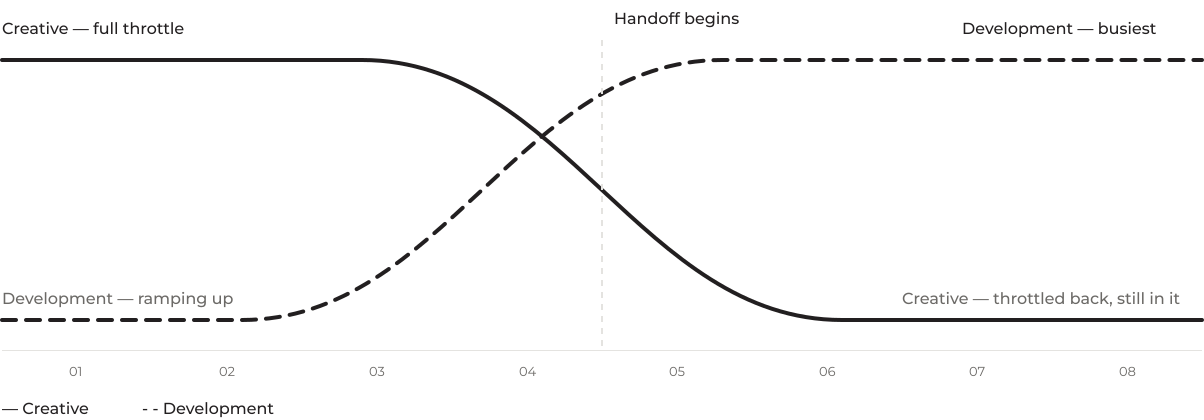
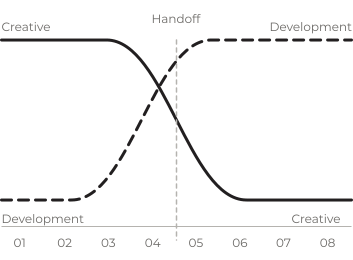
Design runs flat out first. Then the build does.
Early on, design is at full throttle — delivering everything every team needs — while development ramps up. We meet in the middle, and that's where handoff begins. From there the developers are busiest and design throttles back. Both stay in it, start to finish.
HOW THE TEAM WORKS
Three ways I work — every project uses one.
ROLES
- — Design lead — me: direction, reviews, and I still design
- — Designers
- — Developers
RHYTHM
- — Kickoff
- — Weekly touch points
- — Demo at the end of every sprint
HOW IT WORKS
Four steps to week one.
- 1
- 2
- 3
- 4
PROOF
On time, on real projects.